Beyond the black and white lies a world of movement, breath, and the beautiful imperfection of the present moment.
The Silent Dialogue
To the uninitiated, Shodo (the Way of the Brush) may look like the simple act of writing characters. However, it is an ancient Japanese art form that bridges the gap between language and spirituality. Unlike Western calligraphy, which often strives for a mechanical, repeatable perfection, Shodo is an “action art.” It is a physical manifestation of the artist’s state of mind. Each stroke captures a single heartbeat, a single breath, and a single moment in time that can never be erased or repeated.
The Tools of the Spirit
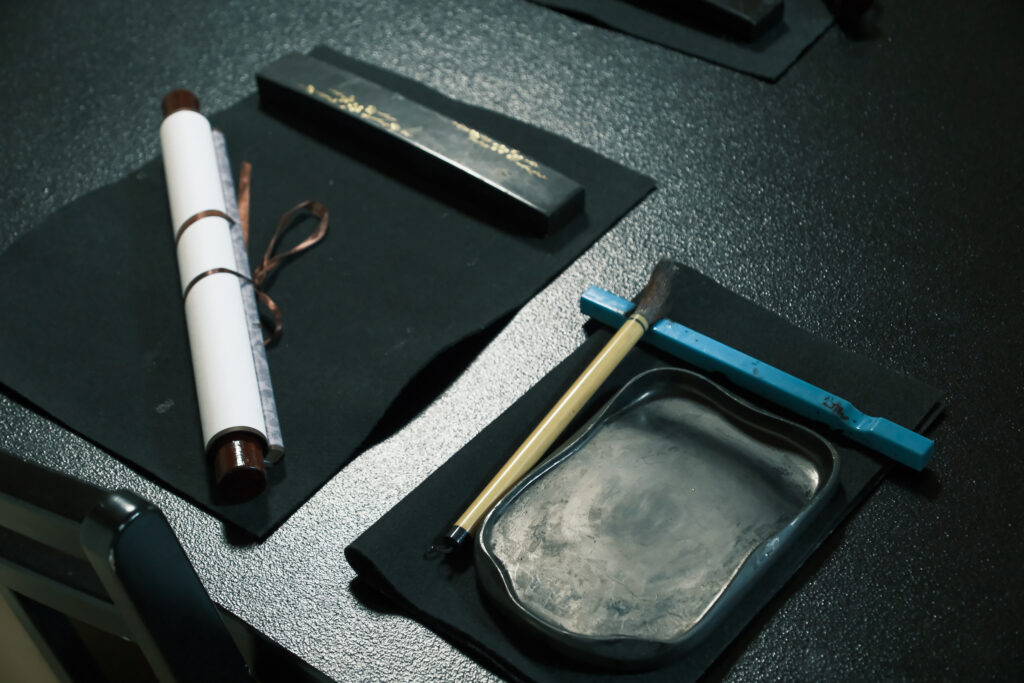
The journey into Shodo begins with the Bunbou Shishou, or the “Four Treasures of the Study.” The ritual of grinding the ink stick (sumi) on the ink stone (suzuri) with a few drops of water is the first step of Green Therapy’s urban cousin: a mental reset. As the scent of the pine-soot ink rises, the practitioner enters a state of focus. The brush (fude), made of natural hair, becomes an extension of the arm, while the thin rice paper (hanshi) waits to absorb not just the ink, but the energy of the person holding the brush.
The Beauty of One Chance
One of the most captivating aspects of Japanese calligraphy for the modern soul is the concept of ichigo ichie—one opportunity, one encounter. In Shodo, there is no correcting a stroke. If a line is too thin or a dot is misplaced, it remains as a testament to that specific moment of human existence. This teaches a powerful lesson in mindfulness: the acceptance of imperfection. To practice Shodo is to let go of the fear of failure and to find beauty in the raw, authentic movement of the hand.
Feeling the Flow
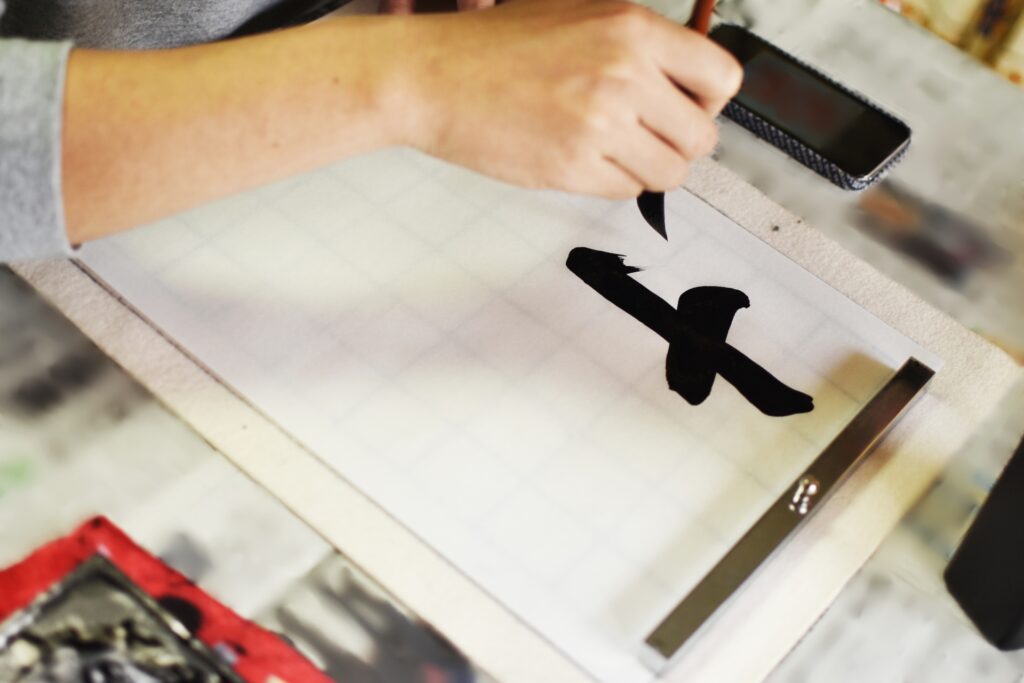
Shodo is often described as “moving meditation.” There are different styles, ranging from the structured Kaisho (block script) to the fluid, abstract Sosho (grass script). In the more cursive styles, the characters become rhythmic waves that convey strength, elegance, or sorrow through the pressure and speed of the brush. For the observer, looking at a piece of calligraphy is an exercise in empathy—feeling the “kiai” (spiritual energy) that the artist poured into the silk or paper.